LensLapse ONNX checkpoints — Pythia suite across training, plus single-checkpoint architecture coverage
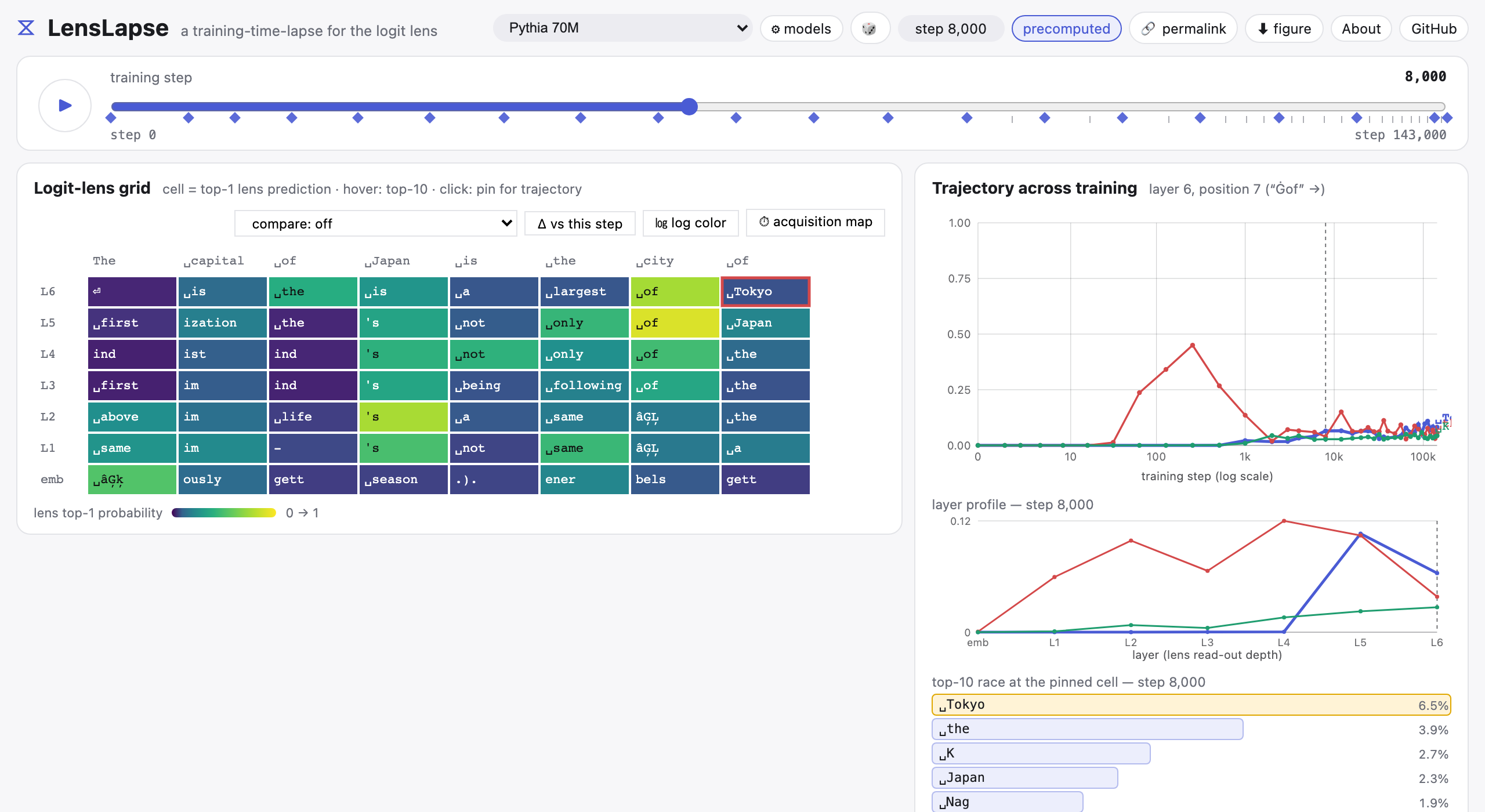
Browser-runnable ONNX conversions of 20 log-spaced training checkpoints each of EleutherAI/pythia-14m, pythia-70m, and pythia-160m, packaged for the LensLapse in-browser logit-lens demo. The remaining directories are single-checkpoint (final-weights-only) examples that demonstrate the same architecture-generic conversion recipe on models the flagship Pythia suite says nothing about — three multilingual suites and, separately, four more decoder architecture families that don’t otherwise change the recipe’s own claim (see Contents below for the full list and what’s proved by each one).
Code: https://github.com/iamtatsuki05/lenslapse
Project page: https://iamtatsuki05.github.io/lenslapse/about/
Demo video: https://www.youtube.com/watch?v=OBnvG9Ru3j8
Contents
One directory per model (pythia-14m/, pythia-70m/, pythia-160m/, gpt2/, mapneo-250m/,
aquila-135m/, bloom-560m/, smollm2-135m/, qwen3-0.6b/, opt-125m/, gemma3-270m/), each
with a manifest.json (steps, per-file sizes, export-time parity metrics).
The three Pythia directories hold one step{N}/ pair for each training step
N ∈ {0, 1, 2, 4, 8, 16, 32, 64, 128, 256, 512, 1000, 2000, 4000, 8000, 16000, 32000, 64000,
128000, 143000}:
file |
interface |
size (14m / 70m / 160m) |
|---|---|---|
|
|
~16 / ~91 / ~249 MB |
|
|
~13 / ~52 / ~77 MB |
gpt2/ ships a single step0/ pair — the released final weights (~250 MB backbone + ~77 MB lens);
GPT-2 has no public intermediate checkpoints.
mapneo-250m/ holds 8 step{N}/ pairs, N ∈ {16780, 33550, 67110, 100660, 201330, 402650, 704640,
1002650} — millions of training tokens, not optimizer steps (MAP-Neo’s own published checkpoints
are labeled by cumulative tokens, e.g. 16.78B; the LensLapse slider needs a single monotonic
integer axis, so the token count in millions is used directly as the step value). Backbone ~372 MB,
lens ~131 MB per step (hidden=1024, 8 layers, vocab=64128).
aquila-135m/ holds 6 step{N}/ pairs at the model’s own published training iterations,
N ∈ {250000, 500000, 750000, 1000000, 1300000, 1410844} (the “pretrain” phase only — Aquila also
publishes a separate, non-contiguous 3-checkpoint “annealing” phase at lower iteration numbers,
excluded here to keep the step axis monotonic). Backbone ~392 MB, lens ~175 MB per step (hidden=576,
30 layers, vocab=151851).
bloom-560m/ holds 8 step{N}/ pairs at the model’s own published training steps,
N ∈ {1000, 10000, 100000, 200000, 300000, 400000, 500000, 600000} (BLOOM’s own checkpoint
revisions are named global_step{N}, matching Pythia’s convention closely enough that no synthetic
step relabeling was needed). Backbone ~1120 MB, lens ~514 MB per step (hidden=1024, 24 layers,
vocab=250880).
smollm2-135m/, qwen3-0.6b/, opt-125m/, and gemma3-270m/ each ship a single step0/ pair —
the released final weights, final-only like gpt2/ (no public intermediate checkpoints). Backbone
~273 / ~1197 / ~252 / ~540 MB, lens ~57 / ~311 / ~77 / ~336 MB (SmolLM2: hidden=576, 30 layers,
vocab=49152, Llama-style RMSNorm; Qwen3: hidden=1024, 28 layers, vocab=151936, Llama-style RMSNorm;
OPT: hidden=768, 12 layers, vocab=50272, GPT-2-style LayerNorm; Gemma 3: hidden=640, 18 layers,
vocab=262144, Gemma-style RMSNorm). Unlike the suites above, these four are included specifically as
architecture-coverage examples rather than for their training-dynamics story, and two of them
exposed real gaps in the conversion recipe rather than just confirming it:
SmolLM2 and Qwen3 already resolved correctly through the existing GPT-NeoX/Llama-style/GPT-2 attribute heuristic with no code change.
OPT did not: its decoder stack sits at
model.model.decoder, two attribute hops belowmodel, which the previous one-hop-only base search could not reach (no block list found on OPTModel);src/lenslapse/arch.pynow resolves dotted multi-hop base paths, verified against OPT and regression-checked against every other shipped architecture.opt-125m/carries a non-permissive, non-commercial license — see License below before using it.Gemma 3 did not either: its RMSNorm computes
normalized(x) * (1 + weight), not thenormalized(x) * weightevery other shipped model uses (Gemma initializes the weight near zero rather than near one, for training stability, and adds the 1 back at call time). The export pipeline’s ONNX reconstruction of the norm previously assumed the plain formula unconditionally, which for a real Gemma 3 checkpoint produced a 23.2 max logit deviation against the fp32 PyTorch reference — caught by the pipeline’s ownassert fp32_diff < 0.05rather than shipped silently.export_checkpoints.pynow probes the real norm module against both candidate formulas on a fixed random vector and reconstructs whichever one it actually matches; fixed,gemma3-270m/passes with a 5.3e-5 max deviation.gemma3-270m/carries Google’s Gemma Terms of Use — see License below (commercial use is allowed, unlikeopt-125m/, but with its own redistribution and prohibited-use obligations).
The backbone outputs the pre-final-layer-norm residual stream after the embedding and after each
transformer block, so applying the lens head to any layer implements the logit lens uniformly, and
applying it to the last layer reproduces the model’s actual output distribution exactly. This
identity — and the export pipeline’s per-checkpoint assertion of it — holds unmodified for MAP-Neo’s,
Aquila’s, SmolLM2’s, and Qwen3’s Llama/Mistral-style RMSNorm architectures, Gemma 3’s
plus-one-weight RMSNorm variant, and BLOOM’s and OPT’s GPT-2-style LayerNorm architectures: the
conversion recipe introspects the decoder stack, final norm, and unembedding generically
(src/lenslapse/arch.py) rather than hard-coding Pythia’s GPT-NeoX layout.
Two further caveats the recipe does not paper over, both caught rather than silently shipped:
Gemma-2-style models (unlike Gemma 3) apply an additional tanh-based final-logit softcapping the
plain final_norm → lm_head path does not reproduce (raw logit deviation of ~51 on a real
checkpoint, though top-1 still agrees since tanh is monotonic) — no Gemma-2-family model is
included here. OLMo-2’s smallest public checkpoint (1B parameters) was also attempted and rejected
for an unrelated reason: its backbone (embedding + transformer stack, ~1.28B parameters) serializes
to ~2.6 GB in fp16, over the 2 GB hard limit of a single protobuf message that plain onnx.save()
enforces; export_checkpoints.py does not currently use ONNX’s external-data format, which would
lift this ceiling. No public OLMo-2 checkpoint small enough to fit is available at the time of
writing.
Fidelity
Weights are stored fp16 and cast to fp32 at session load (compute is fp32). Against fp32 PyTorch,
top-1 lens predictions agree on 100.0% of (layer, position) cells over a 16-prompt suite at steps
8000/64000/143000; the export-time probe over all 20 checkpoints shows a max logit diff of 0.0087.
Dynamic int8 quantization was evaluated and rejected (final-layer top-1 agreement drops to 52%
per-tensor / 71% per-channel at step 143000). See the LensLapse repository for the evaluation
script (src/lenslapse/fidelity_eval.py).
MAP-Neo, Aquila, BLOOM, SmolLM2, Qwen3, OPT, and Gemma 3 were validated with the same per-checkpoint export-time assertion (not the separate 16-prompt/int8 sweep above, which is Pythia-specific): top-1 agreement between the fp32 PyTorch reference and both the fp32-ONNX and fp16-ONNX exports is 100.0% at every (layer, position) cell of the probe prompt, for every shipped checkpoint of all seven models. Max logit deviation from fp32 PyTorch: MAP-Neo 2.6e-5 to 1.6e-4 across its 8 checkpoints; Aquila 1.1e-4 to 1.8e-4 across its 6; BLOOM 8.6e-6 to 7.6e-4 across its 8; SmolLM2 3.03e-4; Qwen3 1.02e-4; OPT 3.19e-5; Gemma 3 270M 5.34e-5.
Reproduce
uv run python -m lenslapse.export_checkpoints --model EleutherAI/pythia-70m --out ./models
uv run lenslapse add-model --model gpt2 --id gpt2 --label "GPT-2 124M" --final-only --models-root ./models
MAP-Neo and Aquila publish checkpoints as subfolders within a single revision rather than one git
revision per checkpoint, Aquila’s tokenizer requires trust_remote_code, and BLOOM’s per-revision
tokenizer files fail to load under current transformers (a transformers-side regression, not a
BLOOM error — its tokenizer is loaded from the final bigscience/bloom-560m repo instead, identical
across checkpoints of the same run); see src/lenslapse/sources.py’s resolve_subfolder_sources /
--subfolder-map, --revision-template, --tokenizer-ref, and src/lenslapse/prompts_zh_en.json (the
combined English + Chinese curated-prompt set used for MAP-Neo, Aquila, and BLOOM as well as the
architecture-coverage examples Qwen3 and Gemma 3 — five multilingual-capable models in total, in
place of the English-only default used by the other six) for the exact commands.
Because MAP-Neo and Aquila’s tokenizers rely on custom Python code (tokenization_neo.py /
tokenization_qwen.py) with no fast-tokenizer (tokenizer.json) equivalent, the deployed web
app’s free-text live probe for these two specifically requires a connected probe server —
transformers.js cannot execute that code client-side. Curated prompts for both are unaffected
(served precomputed, no client-side tokenization needed); see deployment.md’s verification
checklist.
License and attribution
⚠️ Three directories here are not plain Apache-2.0/MIT — read this section before redistributing
or deploying bloom-560m/, opt-125m/, or gemma3-270m/ specifically.
opt-125m/is the one directory in this repo that is not usable commercially. It is derived from facebook/opt-125m, © Meta Platforms, under the OPT-175B License Agreement — a custom, non-permissive license granting rights “solely for your non-commercial research purposes.” No commercial use is permitted at all.gemma3-270m/is derived from google/gemma-3-270m, © Google, under the Gemma Terms of Use. Commercial use is permitted (unlikeopt-125m/), but redistribution — which this repo does, in ONNX form — requires passing the Agreement and its referenced Prohibited Use Policy on to downstream recipients as an enforceable term, carrying prominent notice of any modification, and remains subject to Google’s unilateral right to restrict usage or terminate the Agreement for a violation — obligations no other license in this repo imposes on downstream users.bloom-560m/carries the BigScience RAIL License v1.0 (see below) — broad, including commercial, use subject to behavioral restrictions (Attachment A), with no flow-down or termination clause like Gemma’s.
Every other directory in this repo is Apache-2.0 or MIT with no comparable restrictions. Read each license in full before using the corresponding directory beyond casual/research inspection.
Conversion scripts MIT. The pythia-*/ directories are derived from Pythia weights,
Apache-2.0 © EleutherAI (Biderman et al., 2023, “Pythia: A Suite for Analyzing Large Language
Models Across Training and Scaling”); the gpt2/ directory is derived from
openai-community/gpt2, MIT (Modified) © OpenAI
(Radford et al., 2019). The mapneo-250m/ directory is derived from
m-a-p/neo_scalinglaw_250M, Apache-2.0 © the
M-A-P community (Zhang et al., 2024, “MAP-Neo: Highly Capable and Transparent Bilingual Large
Language Model Series”); its tokenizer is redistributed from the separate
m-a-p/neo_7b repository (same license, same authors — the
scaling-law repos do not bundle a tokenizer). The aquila-135m/ directory is derived from
BAAI/Aquila-135M-Intermediate, Apache-2.0 ©
Beijing Academy of Artificial Intelligence. The bloom-560m/ directory is derived from
bigscience/bloom-560m-intermediate,
© BigScience Workshop, licensed under the BigScience RAIL License
v1.0 — not a plain permissive license: RAIL
grants broad use and redistribution rights but attaches use-based behavioral restrictions (Attachment
A) that bind downstream recipients of these weights. The smollm2-135m/ directory is derived from
HuggingFaceTB/SmolLM2-135M, Apache-2.0 © Hugging
Face. The qwen3-0.6b/ directory is derived from
Qwen/Qwen3-0.6B, Apache-2.0 © Alibaba Cloud / the Qwen
team. The opt-125m/ and gemma3-270m/ directories are derived from
facebook/opt-125m (© Meta Platforms) and
google/gemma-3-270m (© Google) respectively — see the
warning at the top of this section for both. Apart from bloom-560m/, opt-125m/, and
gemma3-270m/, every directory in this repo is Apache-2.0 or MIT. The license metadata field
above names the Pythia license; the other directories keep their own, and downstream users of
bloom-560m/, opt-125m/, and gemma3-270m/ specifically should read those licenses in full
before deploying them. This repo redistributes derived weights unchanged in ONNX form.